MAR 2026: The Price Is WRONG!
The market is flashing contradictions. Public credit spreads sit near historic lows — investment-grade at roughly 70 basis points, high-yield at 90 — signaling calm. But behind the walls of the private credit market, where loans are self-valued and exit doors are narrow, a very different story is developing.
"When public markets show calm and private lenders are getting pummeled, that mismatch is the signal."
Welcome to March 2026, where the price on the surface is wrong. Around $47 billion in tech loans now trade at distressed levels — $18 billion of that moved into distress in a single month. The Federal Reserve flagged it in January meeting minutes, noting "vulnerabilities associated with the private credit sector." And yet spreads haven't budged. That gap between what's visible and what's real is exactly where dividend investors need to stay focused.
THE MACRO PICTURE
The $3 trillion private credit market grew fast during the cheap-money era, taking up slack from banks that retreated from corporate lending. Much of that capital flowed into software LBOs and AI data center buildouts — sectors now under pressure from AI disruption fears and rising rates. The core danger: these are illiquid, self-valued loans. Problems don't surface until they suddenly do.
A major private credit firm's move to sell $1.4 billion in loans at 99.7 cents on the dollar and halt quarterly redemptions in one fund sent shockwaves through the retail investor community — even though the firm positioned it as routine wind-down activity. The stock fell. Contagion fears spread to peers, with one competitor dropping nearly 8% in a single week. Emergency calls with financial advisers followed. Reactions split: some investors redeemed; others doubled down.
EYE ON ILLIQUIDITY RISK
The lesson for dividend investors is not necessarily to flee private assets — it's to know what you own. Thirteen percent of the loans in the sold portfolio were in software, a sector rattled by AI disruption fears. The Fed is watching. The current private credit stress has drawn comparisons to the August 2007 BNP Paribas fund freeze — a canary-in-the-coalmine moment that preceded the 2008 financial crisis by a full year. Whether this is the same movie or just a similar scene remains to be seen. Dividend investors who anchor to cash-generating businesses with transparent balance sheets are better positioned than those chasing yield in opaque structures.
Ticker Spotlight
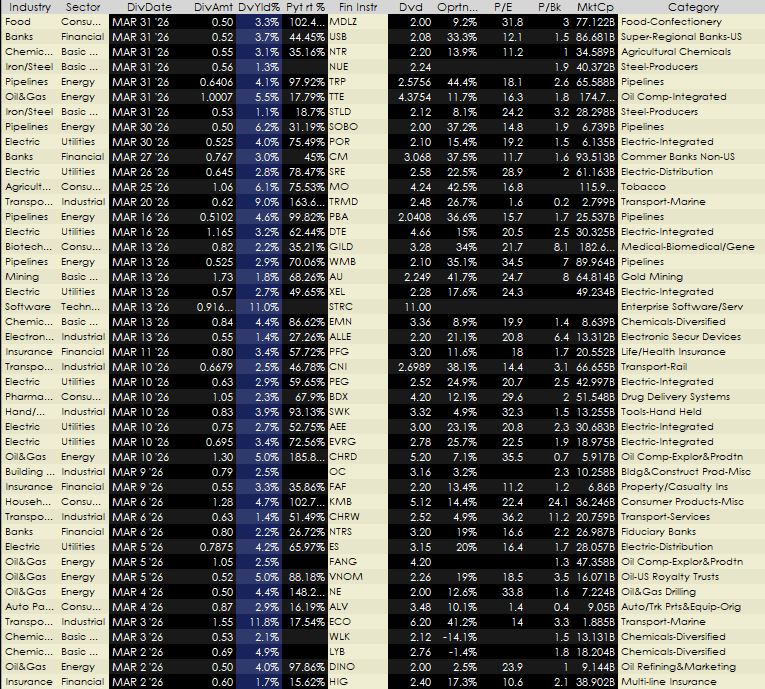
Dividend Screen
March 2026 Dividend Payers — screened for ex-dates between Mar 2–31 ’26. We used a consistent screener process to surface income candidates across sectors ./DIVIDEND_March26.png (updated 2/25/26).
Video Analysis
We discuss the "Twilight Zone" market mechanics and how to avoid behavioral traps.
Model Dividend Portfolio
This model illustrates how an investor might allocate capital across sectors to balance yield and growth. Tailor this to your own risk tolerance.
| Allocation | Sector | Role | Target Yield |
|---|---|---|---|
| 20% | Utilities | Stability Anchor | 4.0% |
| 20% | Healthcare | Defensive Growth | 2.5% |
| 15% | Staples | Inflation Hedge | 3.0% |
| 15% | Technology | Dividend Growth | 1.5% |
| 10% | REITs | Income Booster | 5.0% |
| 10% | Energy | Cash Flow | 6.0% |
| 10% | Financials | Cyclical Upside | 3.5% |
Market Sentiment (UMCSI)
Why it matters: Inflation expectations are watched closely by the Fed. A jump in 1‑year expectations can push yields higher. Currently, sentiment suggests consumers are pulling back, which is historically bad for bonds but offers entry points for high-quality dividend payers.